World Cup matches look familiar, yet feel fundamentally different. The pitch markings are the same, the laws are unchanged, and the players are among the best in the world. But the behaviour inside these matches often feels restrained, cautious, even uncomfortable. That discomfort is not accidental. It is the defining feature of tournament football.
For Australian viewers, World Cup matches are often watched in isolation — early mornings, quiet lounges, minimal noise. That distance strips away hype and exposes what is really happening. And what is happening, more often than not, is a battle against fear, expectation, and irreversible consequence. This article explores why World Cup matches behave the way they do, what consistently decides outcomes, and why control almost always beats expression on football’s biggest stage.
Why World Cup Matches Compress Freedom
In domestic football, freedom grows with familiarity. Players know patterns, teammates, referees, and rhythms. At the World Cup, freedom shrinks instantly.
Players arrive from different leagues, climates, and tactical systems. Preparation time is limited. Errors are magnified. As pressure increases, decision-making narrows.
How freedom disappears at the World Cup
- Risk is delayed rather than embraced
- Safe passes replace creative ones
- Spacing is prioritised over movement
- Individual flair is rationed
World Cup matches are not about expanding options — they are about protecting margins.
The Difference Between Skill and Tournament Intelligence
World Cup history is filled with talented teams that failed early. Skill creates possibility, but tournament intelligence decides survival.
Tournament intelligence is the ability to understand game state: when to slow, when to accept stalemate, and when to gamble.
Signs of high tournament intelligence
- Comfort without possession
- Patience under scoreboard pressure
- Clear leadership during chaos
- Acceptance of unattractive solutions
Teams that master this rarely look spectacular — but they often advance.
Group Matches: Quiet Calculations, Not Statements
Group-stage World Cup matches are often criticised for lacking intensity. In reality, they are full of calculation.
Teams evaluate opponents, manage energy, and protect goal difference. A draw can be strategic. A narrow win can be ideal.
Hidden priorities in group matches
- Avoiding emotional overexposure
- Protecting defensive confidence
- Concealing tactical adjustments
- Managing physical load
The teams that peak too early often pay later.
Knockout Matches: Fear as an Organising Principle
Once elimination begins, fear becomes structural. Players do not panic — they retreat into order.
Attacking numbers drop. Defensive spacing tightens. Coaches delay substitutions. Matches slow.
Knockout-stage behavioural patterns
- Shorter passing sequences
- Lower defensive lines
- Greater set-piece focus
- Comfort with extra time
Knockout World Cup matches are not about courage — they are about restraint.
Why Possession Often Signals Frustration
High possession in World Cup matches frequently indicates difficulty rather than dominance.
Teams defending deep invite circulation in harmless areas, conserving energy while waiting for mistakes.
What matters more than possession
- Shot quality conceded
- Territory gained after turnovers
- Defensive recoveries
- Set-piece frequency
World Cup control is about managing danger, not the ball.
The Middle Minutes: Where Matches Are Silently Won
Between the opening intensity and late desperation lies the most decisive phase of World Cup matches.
Fatigue creeps in. Communication slips. Defensive lines stretch subtly.
Warning signs during this phase
- Late pressing triggers
- Rising foul counts
- Poor second-ball control
- Misaligned defensive spacing
Teams that stabilise this phase usually decide the outcome.
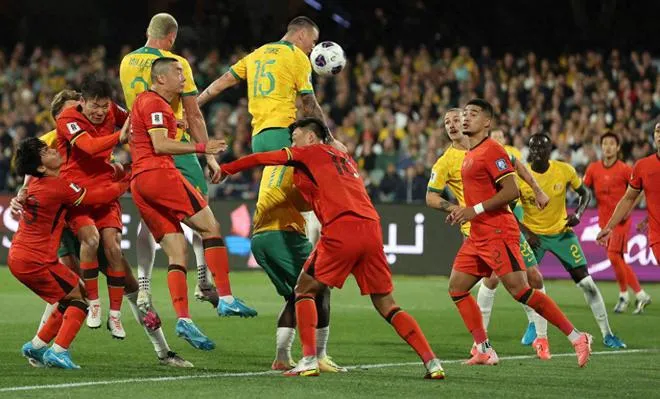
Set Pieces: The Tournament Equaliser
Set pieces matter more at the World Cup than in almost any other competition.
They bypass emotional restraint and create moments of forced confrontation.
Why dead balls decide matches
- Reduced reaction time
- Physical mismatches
- Rehearsed movement patterns
- Goalkeeper pressure
A single corner can outweigh ninety minutes of open play.
Fatigue That Changes Decisions, Not Speed
World Cup fatigue is rarely visible. Players do not slow dramatically — they hesitate.
A fraction of delay creates space. A late step creates fouls. A slow recovery creates goals.
Subtle fatigue indicators
- Missed tracking runs
- Overhit clearances
- Late tackles
- Reduced off-ball movement
Managing fatigue is often the difference between progress and exit.
Defence as Emotional Control
Elite World Cup defence is not passive. It is emotionally exhausting for opponents.
By denying space repeatedly, defenders force attackers into impatience and low-percentage decisions.
Defensive traits that win tournaments
- Compact spacing
- Minimal fouling near the box
- Clear communication
- Consistent recovery structure
Frustration produces more goals than aggression.
Why Coaches Delay Substitutions
Substitutions in World Cup matches carry disproportionate risk.
Every change threatens rhythm, spacing, and emotional balance.
Why coaches hesitate
- Fear of structural breakdown
- Loss of defensive chemistry
- Emotional instability
- Game-state disruption
Stability often outweighs fresh energy.
Why Underdogs Look Clearer
Underdogs arrive at World Cup matches without legacy pressure. That freedom sharpens focus.
Their objectives are narrow, their roles defined.
Underdog advantages
- Clear defensive identity
- No obligation to dominate
- Efficient counter-attacks
- Set-piece emphasis
Clarity consistently outperforms confidence.
The Australian Viewing Perspective
Australians watch World Cup matches without constant media reinforcement.
This distance allows patterns to emerge without noise.
What becomes clearer from afar
- Shape discipline
- Tempo management
- Emotional reactions
- Referee influence
Perspective improves understanding.
Why World Cup Matches Resist Prediction
World Cup matches compress uncertainty.
Small margins carry massive weight: deflections, referee decisions, momentary lapses.
Why forecasts fail
- Short sample sizes
- Emotional volatility
- Set-piece randomness
- Accumulated fatigue
Unpredictability is not a flaw — it is the tournament’s essence.
FAQ: World Cup Matches
Why do World Cup matches feel tense?
Because mistakes carry irreversible consequences.
Why do star players struggle?
Because freedom disappears under pressure.
Why are goals often scarce?
Because risk is carefully rationed.
Final Reflection: Why These Matches Endure
World Cup matches endure because they reveal something deeper than football ability. They show how humans behave when comfort is stripped away.
For Australian fans watching quietly, these games offer insight rather than spectacle.
At the World Cup, skill opens doors — but nerve decides who walks through them.